Best practices for ecodesign in anticipation of the end of life of equipment containing refrigerant fluids
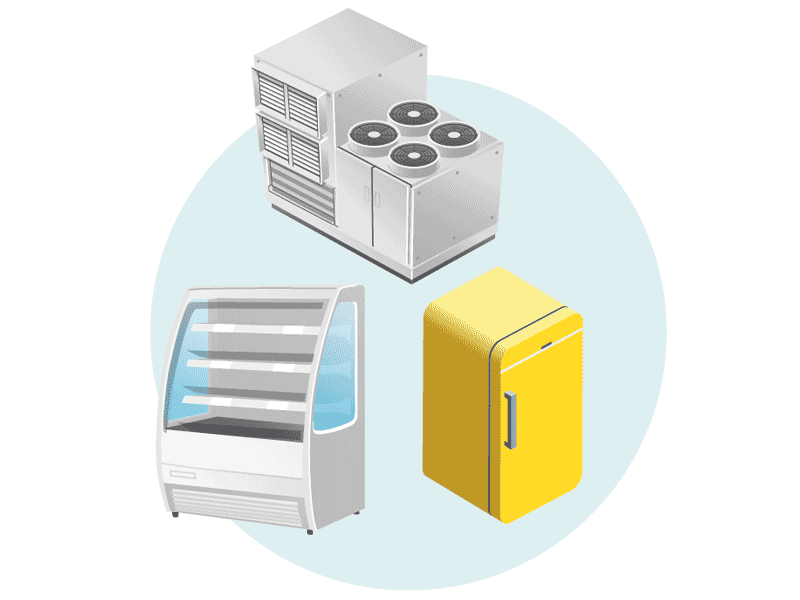
Examples of equipment concerned: refrigerators, freezers, air conditioner appliances, cooling display units….
Materials selection
Materials to be avoided
• Plastics
Limit the variety of resins used, preferring largely recycled resins such as PP, ABS, PS and to a lesser extent, ABS/PC and PC.
In the WEEE sector, some resins are easier to recycle because:
- Appropriate recycling operational technologies are available to produce new resins (e.g. thermoplastic vs. thermoset resins).
- They have specific technical features (including their density) enabling their identification, and thereby their efficient sorting.
- They are present in large quantities making their recycling efficient from a technical and economic point of view.
Limiting the variety of resins used while focusing on the resins mentioned opposite thus leads to an increase in the equipment recycling rate.
• Other
Whenever possible, avoid using the materials listed below, as they are hardly recycled as part of the treatment process of small electrical and electronic appliances:
- wood,
- composite materials,
- mineral materials,
- bio-sourced material.
Some materials are not commonly used in large equipment containing refrigerant fluids. Thus, following the different treatment stages, these parts that are present in small quantities are not specifically detected by the sorting techniques. These remaining fractions are not recycled but only recovered to produce energy in certain cases, or even disposed of (by incineration or secure landfilling).
Preferably use single-material components rather than composite materials whenever possible.
Multi-material components (e.g. composite materials, bi-injected or co-extruded plastics...) cannot be totally separated during grinding processes. They will thus be turned into fragments made up of several materials at the end of the process. These fragments disturb the sorting processes and/or affect the performance of downstream sectors of recycling for each of these fractions.
Coatings and surface treatments
Promote the use of plastics dyed in the mass instead of surface coatings, and limit surface treatments on plastic components whenever possible.
Coatings and surface treatments (paint, metallisation...) generate sorting errors when materials are separated using optical sorting technologies. Plastic fragments may thus be considered as non-recyclable because the optical technology will only analyse the material surface, rather than the plastic resin itself. If these plastic fragments are nonetheless directed to the relevant downstream sector of recycling, these coatings/treatments may limit the performance of plastic regeneration plants and/or affect the properties of recycled plastics.
Avoid the use of non-ferrous metal treatments or coatings on ferrous metal components.
Using non-ferrous surface treatments on ferrous metal components (e.g. copper coating on a steel component) disturbs detection operations, and thus magnetic metal separation. These parts may not be directed to the relevant downstream sector of recycling.
Presence of fillers/ additives in materials
In the absence of regulatory requirements relating to product safety, avoid incorporating flame retardants into plastic components. If these requirements involve the use of flame retardants on some components, prefer non brominated flame retardants.
The presence of brominated additives may require specific sorting prior to disposal in a hazardous waste incineration unit, as some of them are now prohibited. The technologies currently available cannot distinguish prohibited brominated additives from other authorised additives (containing bromine or not). This oversorting process thus results in the loss of plastic material to be recycled. It is therefore important to limit, as far as possible, the use of brominated flame retardants, and more broadly, the integration of flame retardants, whenever the regulatory requirements relating to product safety allow it.
Avoid incorporating fillers (mineral or vegetal) into plastics whenever possible.
The presence of fillers in plastics alters the density of resins, and thus disturbs the systems sorting plastics by resin family in preparation for their regeneration.
Selection of joining types
Irreversible materials combination
• plastics combined together
Limit the irreversible assemblies of different resins whenever possible. If no suitable alternative can be found, use resin couples with substantial compatibility during recycled plastic regeneration processes* as soon as possible:
- ABS and PC;
- ABS and ASA
- PP and PE
* In these examples, the first of the two resins should account for more than 80%
Treatment processes cannot separate different resins that would be combined irreversibly (e.g. gluing, bi-injection, co-extrusion..). Yet, most resins are not chemically compatible and the fractions combined irreversibly thus cause significant disruption in the downstream sectors of plastic recycling. For that reason, limiting the use of different resins for the same component is a real action lever in favour of plastic recycling. If no suitable alternative can be found, choose the combinations mentioned in the opposite list.
• plastics combined with other materials
Whenever possible, avoid over-moulding and gluing plastics on other materials such as glass or metals.
Grinding processes cannot totally separate components that have been combined irreversibly. These parts will thus be turned into fragments made up of several materials at the end of the process. These fragments disturb the sorting processes and/or affect the performance of downstream sectors of recycling for each of these fractions.
• metals combined together
Whenever possible, limit the irreversible combination (e.g. riveting) of ferrous and non-ferrous metals, in particular copper and steel components.
These combinations prevent the efficient separation of these materials, while they must follow different downstream sectors of recycling. These fragments, mixing ferrous and non-ferrous metals, therefore disturb the downstream sectors of treatment for each of these fractions.
Joining methods
Use clips instead of screws to fix parts that will rarely be separated.
Fixing techniques including clipping enable the easy separation of components during the different hand operations, but particularly in the grinding machine. It is thus possible to collect fragments consisting of one material, which will be more easily detected and sorted, before being treated in relevant downstream sectors.
Issues surrounding decontamination
Refrigerant fluids
Preferably use refrigerant fluids and gases contained in insulating foams with a low Global Warming Potential (GWP). Indicate the type of gas and refrigerant fluid used directly on the appliance (e.g. on the nameplate or the rear panel).
Global Warming Potential (GWP) represents the impact of a gas on global warming. The WEEE Directive (Directive 2012/19/EU) requires that for equipment containing gases with a Global Warming Potential ( GWP) above 15, these gases shall be removed and treated following specific processes. As a reminder, you can find the timeline regarding refrigerant gas and fluid restrictions ( placing on the market, maintenance and refilling) by equipment category in the Regulation F-Gas ( N°517/2014).
Protect and/or reinforce the refrigerant fluid circuit so it may not be damaged during equipment handling operations.
The majority of refrigerant fluids have a very high Global Warming Potential (GWP). The circuit containing the refrigerant fluid may be damaged (user handling, transport, handling on the treatment site) before the decontamination stage, leading to the release of this fluid into the atmosphere. It is thus important to protect and/or reinforce the circuit.
Subject to technical constraints, propose a zone where refrigerant fluids may be drained easily.
Easy access to the refrigerant fluid circuit enables operators in charge of decontamination to remove the refrigerant fluid completely without any leakage, before it follows a specific downstream treatment. For equipment containing more than 2 kg of refrigerant fluid, this decontamination stage shall be carried out directly on the site where the equipment is used. For other equipment, decontamination shall be carried out on the site where end-oflife equipment is treated.
Circuit boards
For easy removal of circuit boards:
- prefer clipping to fix them on the support,
- limit the number of fixing points.
Circuit boards are components requiring a specific treatment as described in the WEEE Directive ( Directive 2012/19/EU). They must be removed from the early treatment stages in order to be directed to specific treatment sectors. Moreover, they contain critical metals whose recycling is an important challenge in environmental and economic terms and resource availability. Some assembly methods make their removal more difficult, thus reducing the recycling rate of these critical metals.
Other materials
If the equipment contains any insulating material other than PUR foam, indicate the type of material used directly on the equipment (e.g. on the nameplate or the rear panel).
Cooling equipment using any insulation materials other than PUR foams (fibre panels containing mineral particles, Vacuum Insulation Panels…) may go through a specific treatment procedure. For example, fibrous insulation panels may generate significant quantities of dust during grinding, and disturb the functioning of the treatment chain. It is thus important to be able to visually identify this equipment before treating it.